
Griffin Chairs: Both naive and refined
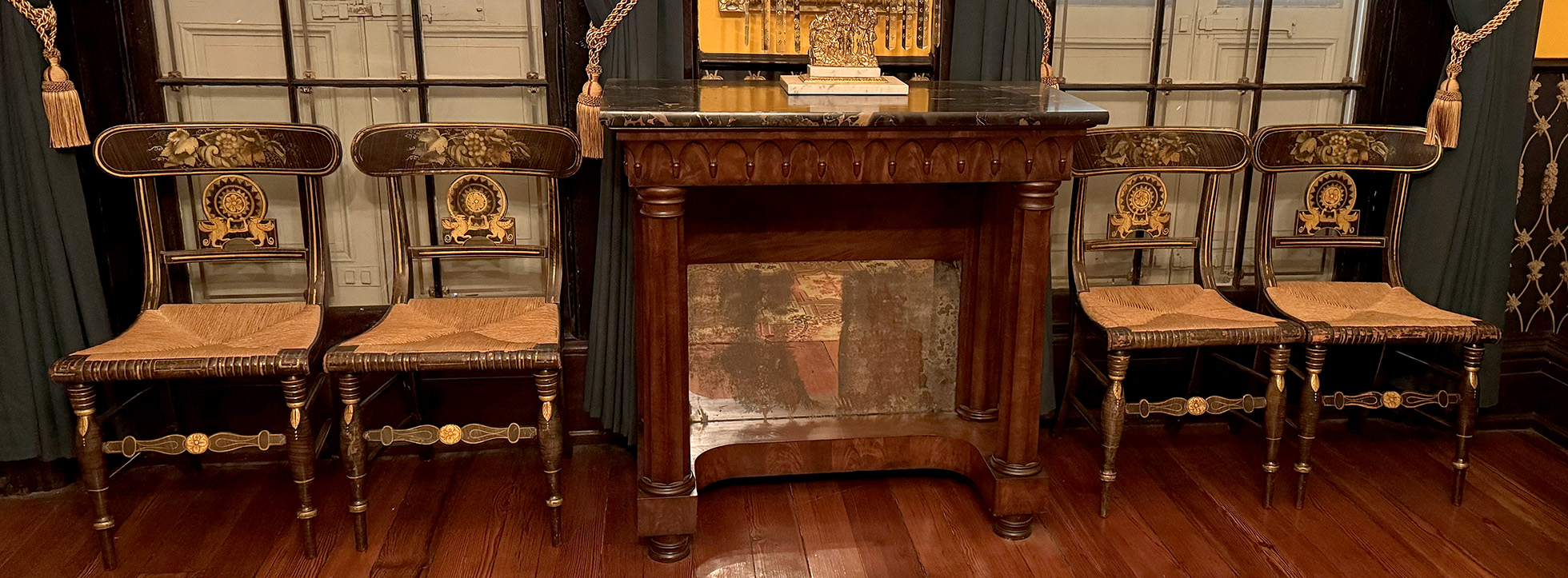
The four newly acquired side chairs join a Boston 1820s pier table in the dining room.
Introduction
The arrival of furniture elicits two questions: (1) why did I buy it and (2) where will it go. Fortunately the second question was answered more easily and satisfyingly than anticipated. Instead of needing to decide what other furniture would be shown the door, I placed the four new chairs (above) in front of the shuttered windows in the dining room. Their gilt surfaces immediately brought light back into the room where the shutters had closed off light. It’s the first question–why did I buy them–that is the subject of this ART I SEE blog post.
Maybe I should substitute the question. I bought them because I’m infatuated with early 19th century formal American furniture: the chairs looked like prime examples of what’s called “fancy” furniture and they were affordable. As always when something new arrives in the house, the real question becomes: What are they actually? Are they what I think they are and are they in the condition I hope they are?
The listing in the Brunk Sept. 11, 2025 auction (Asheville, NC) simply read:
Fine Set of Four American Classical Grain Painted, Stenciled, and Gilt Side Chairs
“Mid Atlantic states, 1820-1840, each finely decorated ‘fancy’ chair with rush seat and loose cushion, 33 x 17-3/4 x 18-1/2 in. Provenance: An Important Atlanta Private Collection”
That’s not a lot of information. (The “loose cushion” referred to four cushions with corded tassels that sit atop the chairs. They are in rough shape. Fortunately the muslin-covered inner pillows, filled with down, have survived and will be reused when new show fabric is applied.) Yet the photos used in the auction listing were enough to begin searching for comparable chairs.
I’m presenting this search almost in chronologic order, so readers can sense how one source can lead to another.
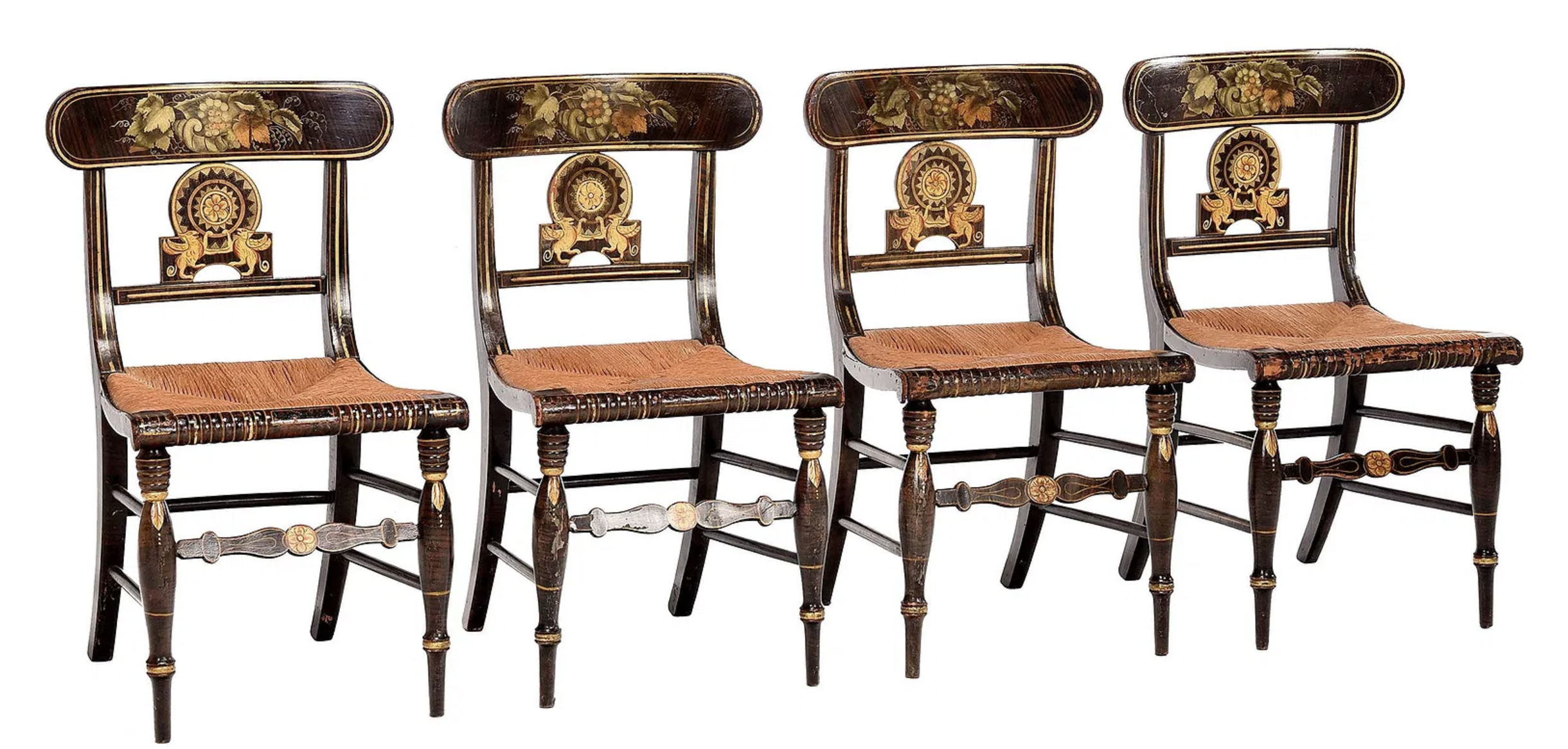
Brunk Auctions photo
RESEARCH begins: legs
To start research it’s useful to look at the components of the chairs.
- The wood frames are painted with base coats faux grained to look like rosewood. Then there were areas of freehand painted stripes, other areas gilded with freehand painting on top, and other areas where powdered metals are applied through stencils with freehand painted details on top.
- The seats have replaced rush.
- The forelegs are lathe turned with four narrowing ring turns atop a long tapering inverted baluster, atop at the ankle three ring turns–the center one wider than the others–then a tapering foot. The klismos back-swept rear legs continue up to become styles to which the crest rails are attached.
- There are six stretchers between the legs. All are simply tuned except the front one which is flat and shaped.
- The crest rail is broad and curved and extends past the styles. The ends of the crest rail are rounded.
- The stay rail is simple with the purpose of supporting the splat.
- The splat is shaped to accommodate the large disc and a pair of griffins.
I find that often the best way to find comparable is to look at the forelegs.
First of all, I know of no books devoted to chairs with similar legs, which are not the legs found on Hitchcock chairs (The Hitchcock Chair, John Tarrant Kenny, Clarkson N. Potter, New York, 1971), Baltimore chairs (Baltimore Painted Furniture 1800-1840, William Voss elder, The Baltimore Museum of Art, Baltimore, 1972), rural Pennsylvania chairs (Country Chairs of Central Pennsylvania, Marie Purnell Musser, 1990) or chairs in the Waln suite of fancy furniture (Classical Splendor: Painted Furniture for a Grand Philadelphia House, Alexandra Alevizatos Kirtley and Peggy A. Alley, Philadelphia Museum of Art, Philadelphia, 2017).
That meant scouring books devoted to painted furniture like American Painted Furniture (Cynthia V.A. Schaffner and Susan Klein, Clarkson Potter, New York, 1997) and American Fancy (Sumpter Priddy, Chipstone Foundation, Milwaukee, WI, 2004) to no avail. Then I turned to American Painted Furniture, 1660-1880 (Dean A. Fales, Jr.,Bonanza books, New York, 1972).
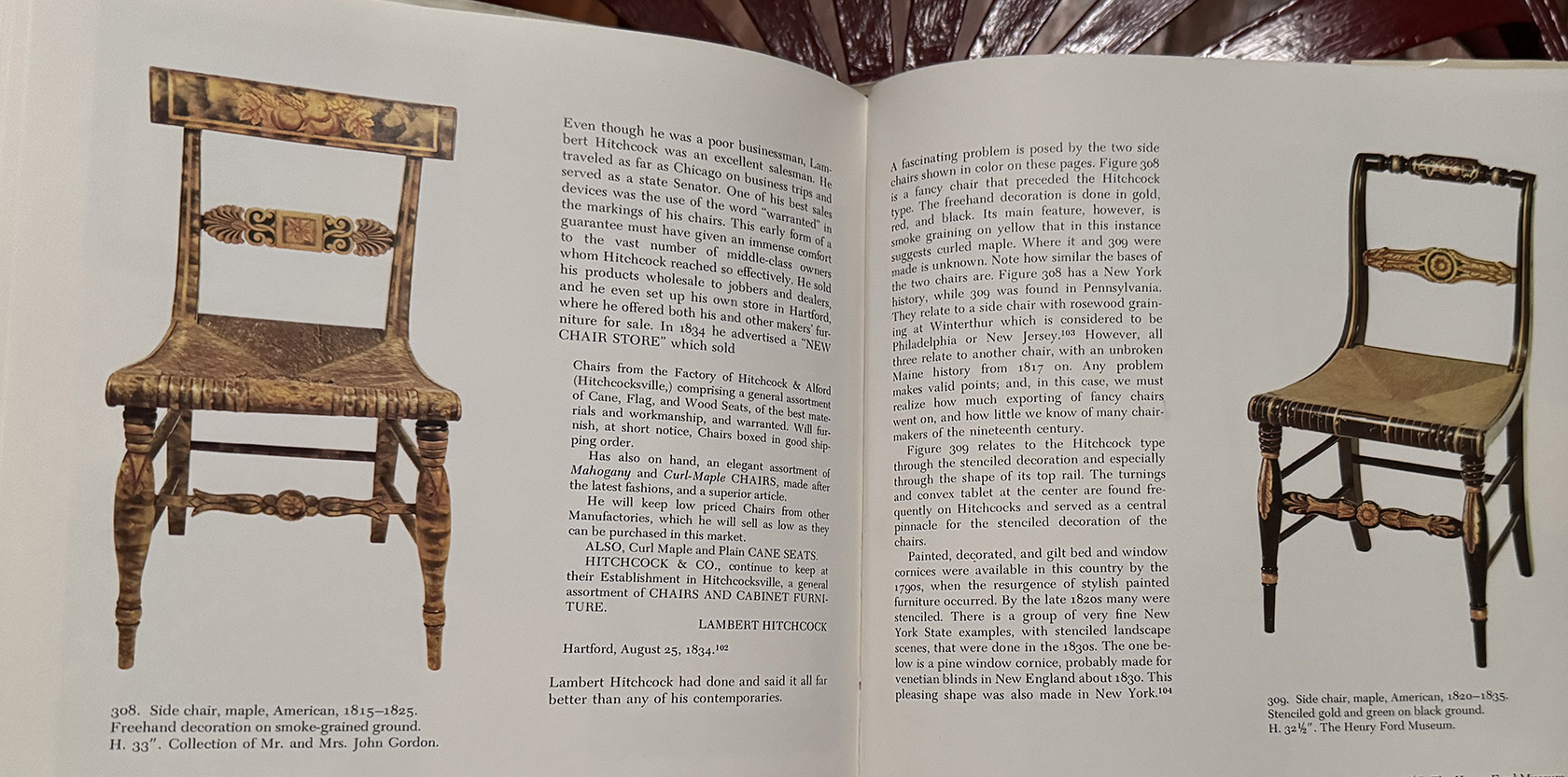
Pages 192 and 193 in Dean A. Fales Jr.’s book
In Fales’ description of #308 he wrote, “Where it and 309 were made is unknown. Note how similar the bases of the chairs are. Figure 308 has a New York history, while 309 was found in Pennsylvania. They relate to a side chair with rosewood graining at Winterthur which is considered to be Philadelphia or New Jersey. However all three relate to another chair, with an unbroken Maine history from 1817 on. Any problem makes valid points; and, in this case, we must realize how much exporting of fancy chairs went on, and how little we know of many chair makers of the nineteenth century.”
That bit of wisdom should settle my search for who made it and where; however, I then turned to general books on American chairs.
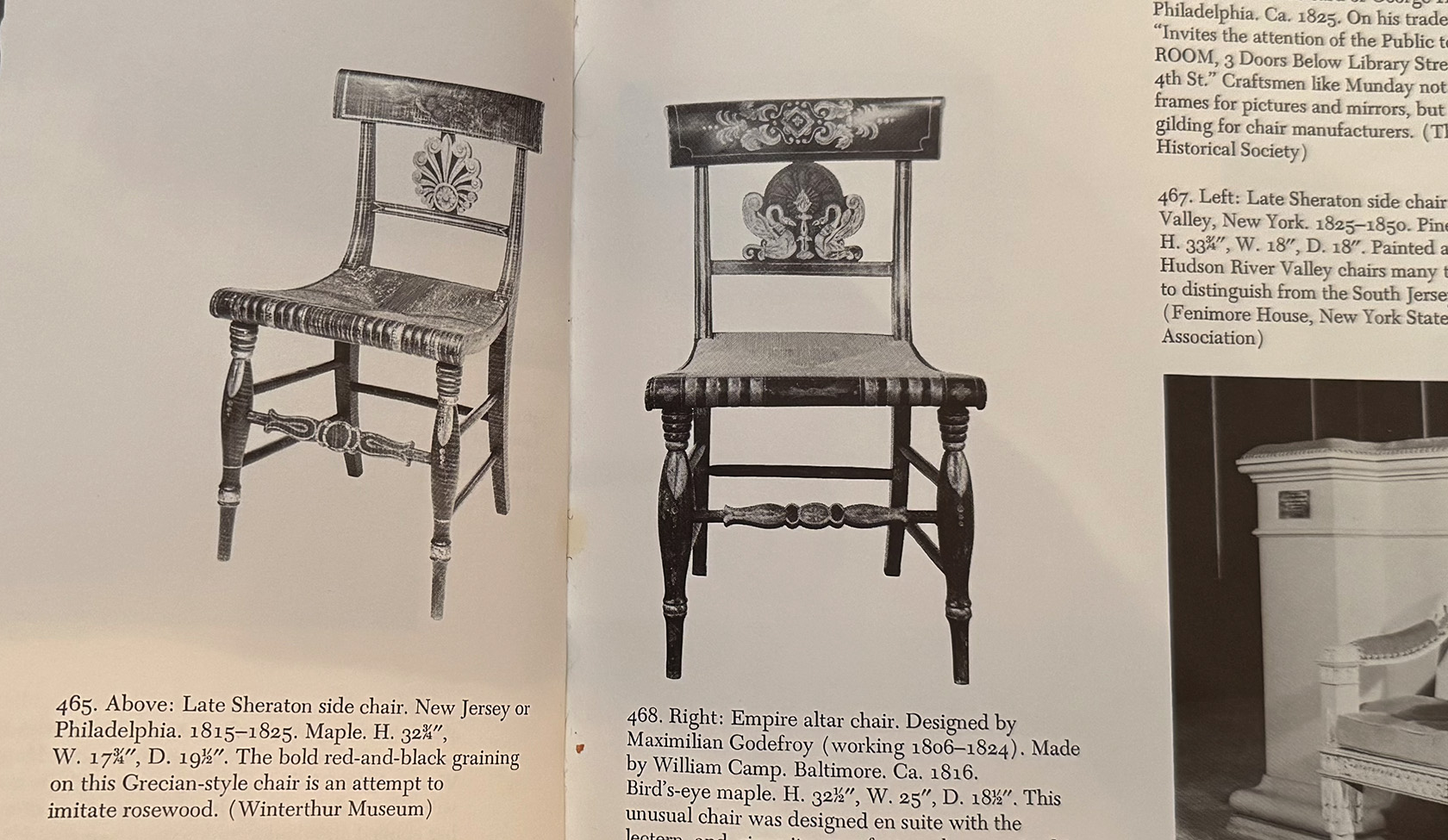
Pages 292 and 293 in the Robert Bishop book
These photos appear in The American Chair (Robert Bishop, Bonanza Books, New York, 1963). The legs match those on the set I bought. The front stretchers are similar. The splats are also the focal point, an anthemion on the chair on the left and a pair of swans on the right chair. Both stenciled crest rails are broad and are affixed in front of the styles. #465 (left) is identified as New Jersey or Philadelphia, 1815-25. While #467 (right) is cited as Hudson River Valley, New York, 1825-50.
So with several references to a possible Philadelphia as a focal point, I thumbed through the pages of Philadelphia Empire Furniture (Allison, Jonathan A., John William, Peter and Christopher Boor, Boor Management, Philadelphia, 2006).
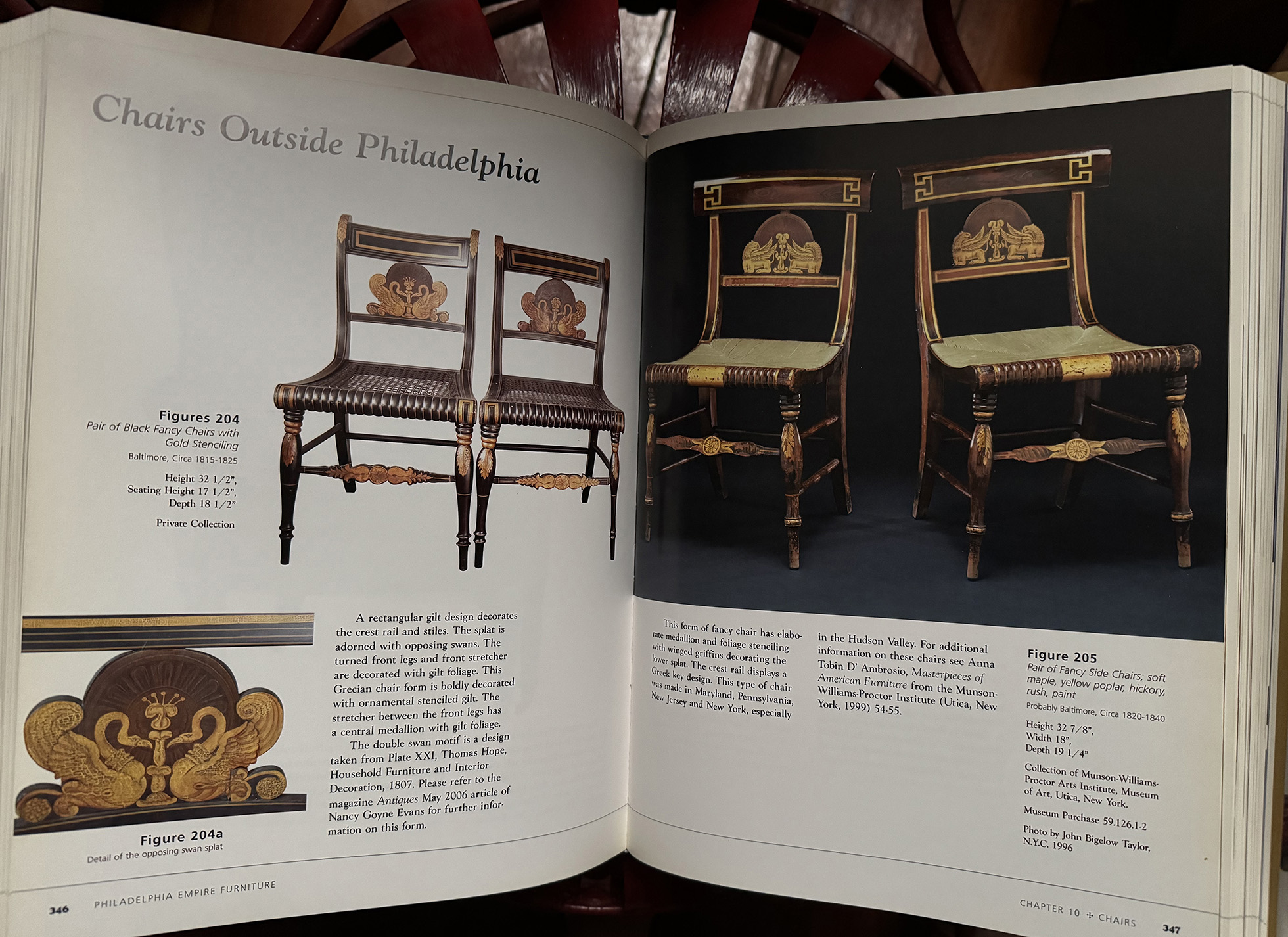
Pages 346 and 347 in the Boors’ book
Oddly enough, the chairs most similar to my set were left to pages headlined “Chairs Outside Philadelphia.” The one with the swans is listed as “Baltimore, Circa 1815-1825” and one with the griffins as “Probably Baltimore, Circa 1820-1840.” Then, for the first time, I read: “This type of chair was made in Maryland, Pennsylvania, New Jersey and New York, especially in the Hudson Valley,” followed by a reference to a book I don’t have. So in the mode of good reporting I order a copy of the book–Masterpieces of American Furniture from the Munson-Williams-Proctor Institute (Anna Tobin D’Ambrosio, Utica, New York, 1999)–with the proviso that the bookseller would quickly photograph pages 54-55, as cited in the caption below the chair on the right.
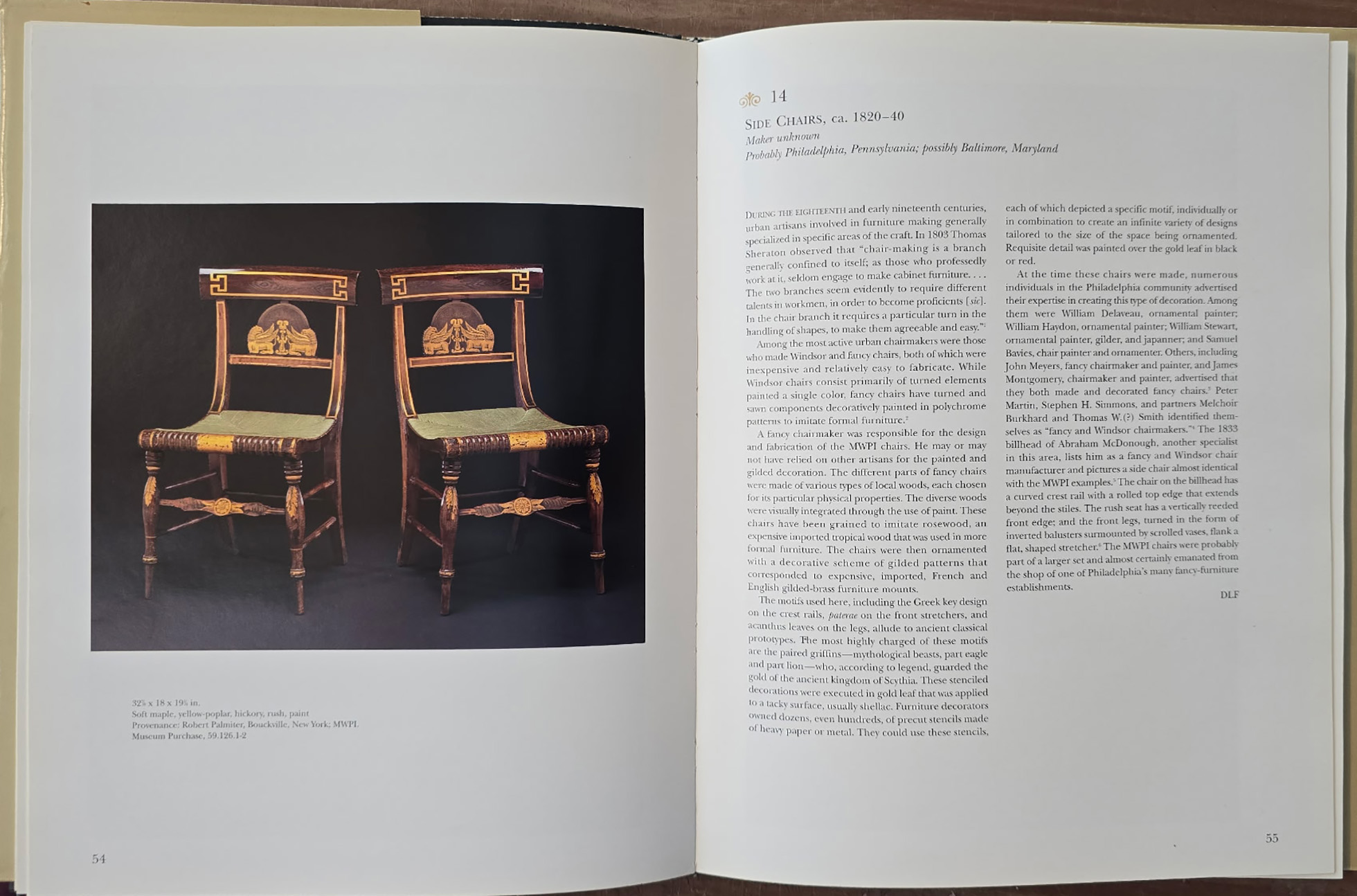
The bookseller promptly supplied this image of pages 54-55. The author, identified as DLF, gives a probable location for their manufacture as Philadelphia, “possibly Baltimore, Maryland,” and writes: “The most highly charged of these motifs are the paired griffins–mythological beasts, part eagle and part lion–who, according to legend, guarded the gold of the ancient Kingdom of Scythia. These stenciled decorations were executed in gold leaf that was applied to a tacky surface, usually shellac…. Requisite detail was painted over the gold leaf in black or red.”
Safe to say I can’t further narrow down the locale for the production of my new chairs, but I can begin discussing the particulars of my chairs.
research focus: griffins
Again I’m in debt to the Boors’ book because the text beside the enlargement of the swans splat on page 346 reads: “The double swan motif is a design from Plate XXI, Thomas Hope, Household Furniture and Interior Decoration, 1807.”
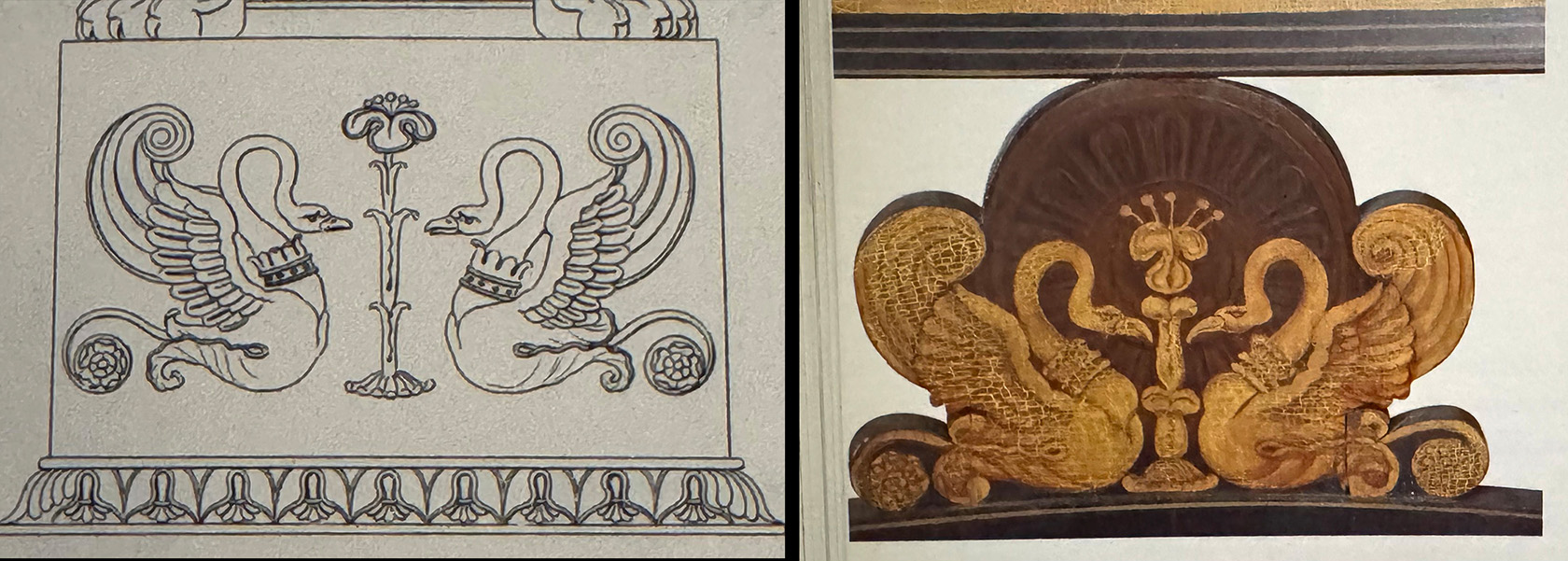
On the left is a closeup of XXI of Hope’s book. On the right is a blowup of the facing swans from Boor page 345.
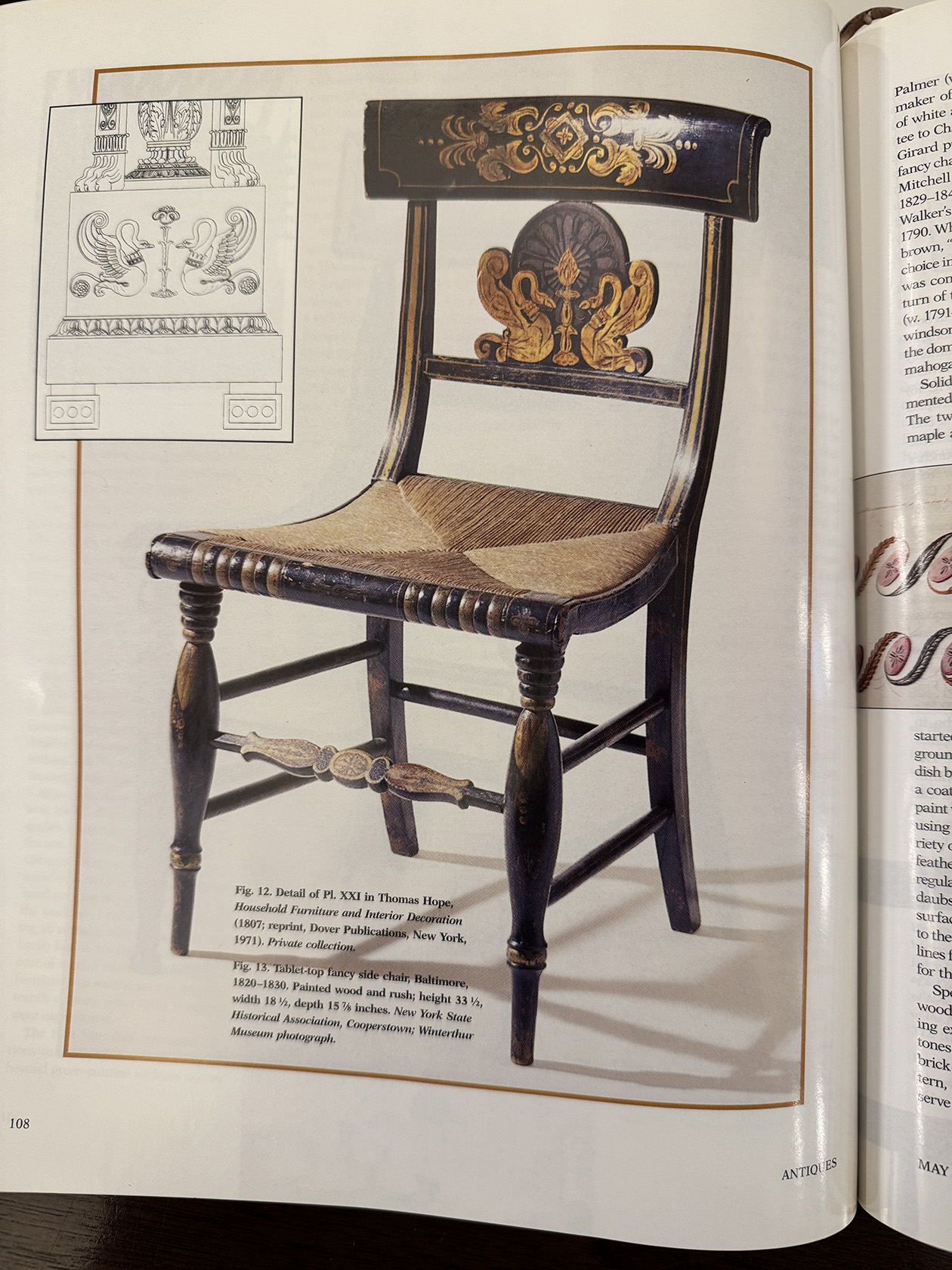
Page 108 from the May 2006 issue of the magazine Antiques.
I also followed the notice on that page in Boor to check out the May 2006 article in magazine Antiques for “Paint and Ornament on Federal Period Vernacular Chairs,” an article by Nancy Goyne Evans, who is probably best known for the three hefty volumes on American Windsor chairs.
Her article pictures the chair on the right (which looks identical to one that Robert Bishop used on page 293). She writes: “The tablet-top Gracian chair in Figure 12 presents a different interpretation of the paired-swarm motif, a popular ornament in Baltimore. The sophisticated gilded birds are created with painted lines and shading. For this work Whitlock suggests that ‘burnt Sienna and lake [a publish red pigment] form a fine warm shade; and for the darker parts vandyke brown.’ The original inspiration for the paired-swan motif in chairmaking appears to be based on an exotic design on griffins and scrolling foliage published by Sheraton in 1793 in his Drawing Book. Winged animals with scrolling foliage, also form part of Thomas Hope’s (c. 1790-1831) more advanced classical furniture designs of 1807.”
She remarks that, since the swans on Hope’s plate XXI and those on the splat of the pictured chair are “virtually identical, suggesting that someone in Baltimore, craftsman or consumer, owned a copy of Hope’s designs.”
Because the chairs don’t share the same legs as the four I bought, I almost forget to check (and not just mention as I did earlier) Kirtley’s and Olley’s book Classical Splendor: Painted Furniture for a Grand Philadelphia House.
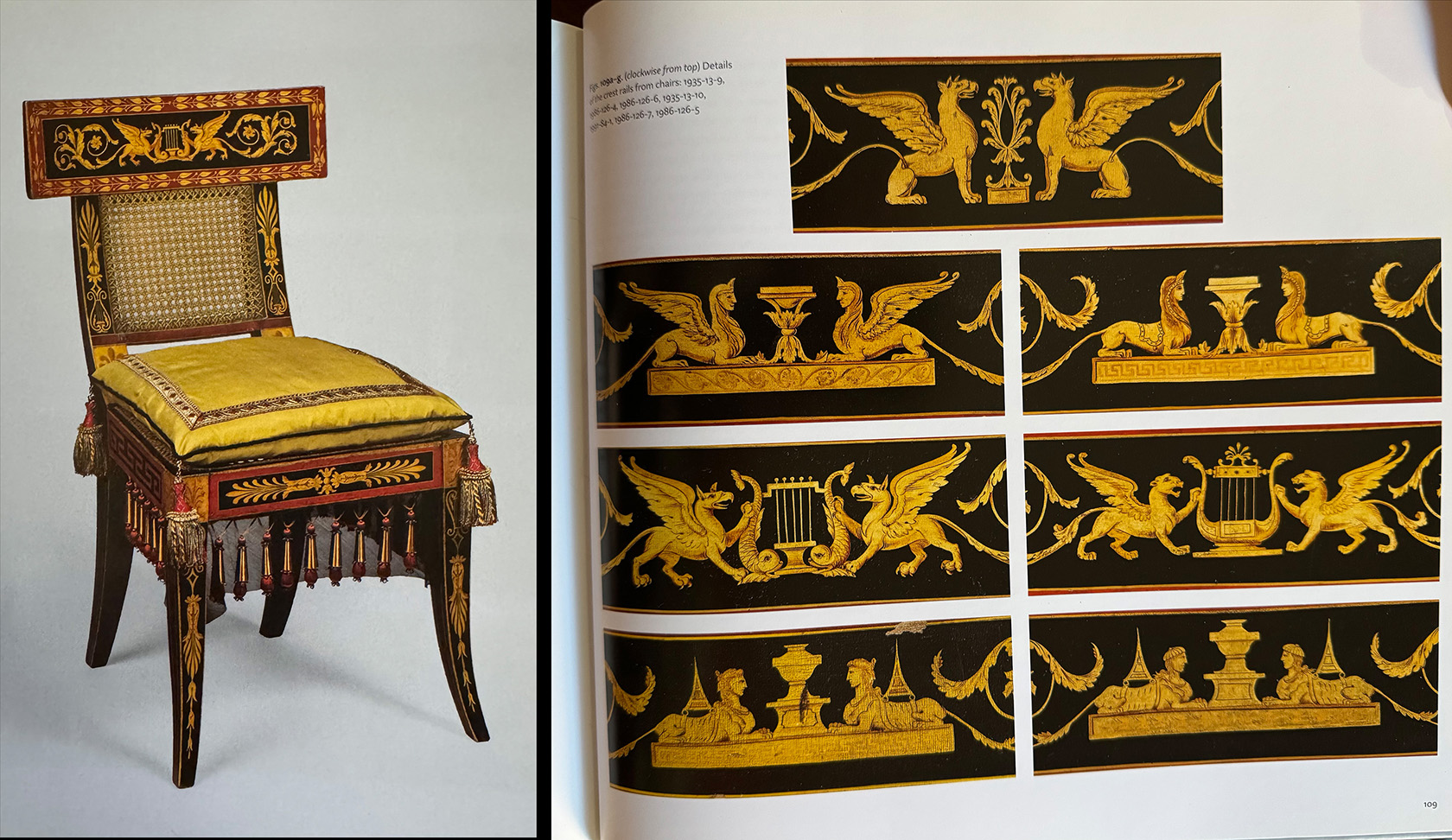
Photos from “Classical Splendor: Painted Furniture for a Grand Philadelphia Hous”e
That would have been a mistake because the crest rails of all the surviving seven side chairs from the suite have gilt and painted pairs classical figures adapted from ancient Roman designs. A card table, a backless couch and a pier table also have survived from a suite that Benjamin Henry Latrobe designed and John Aiken may have made and George Bridport painted in 1808. The suite was made for the William and Mary Wilcocks Waln’s house on Chestnut Street in Philadelphia and is now in the collection of the Philadelphia Museum of Art.
Pictured above is one of the side chairs opposite closeups of all seven crest rails.
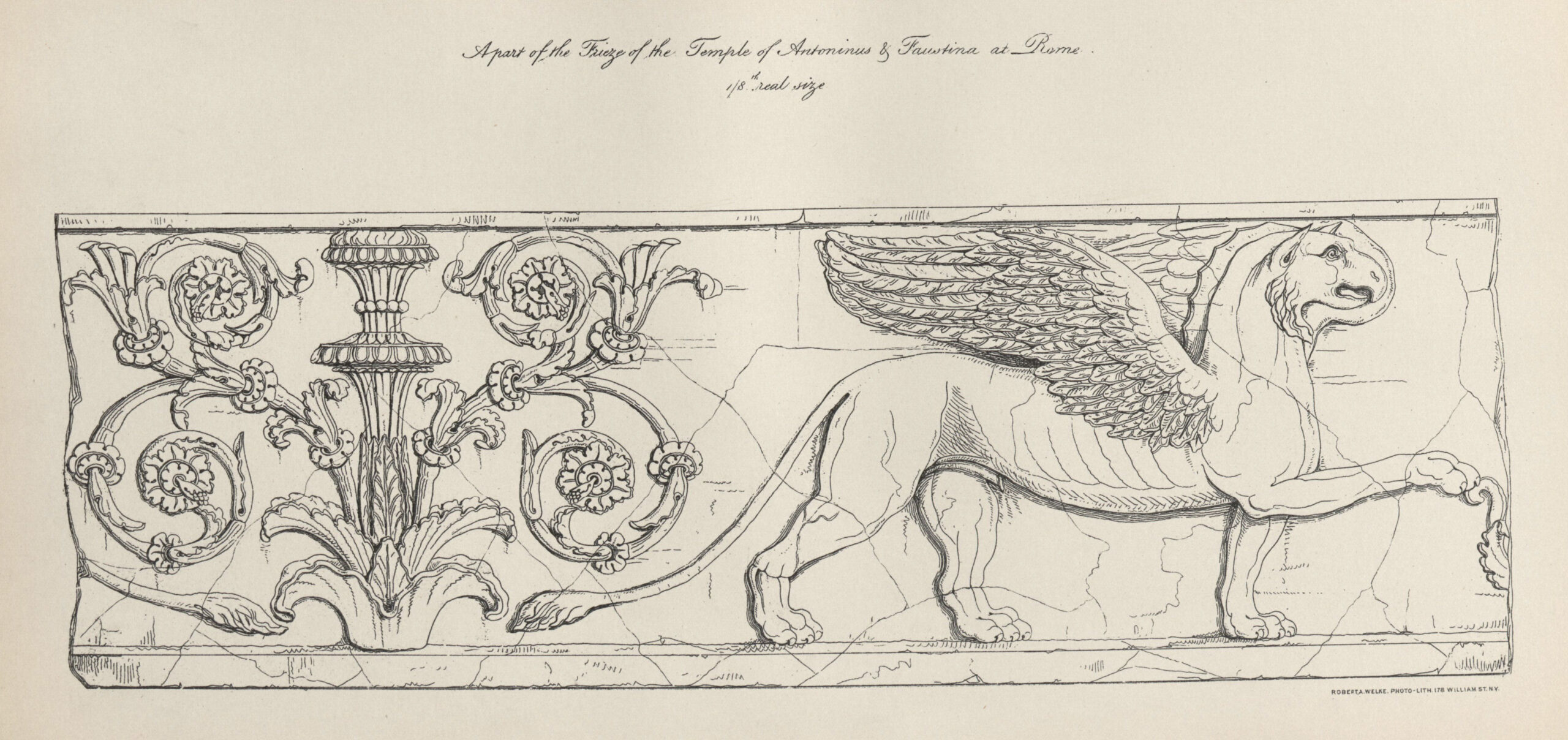
This image from a 1890s reproduction of Tatham’s “Etching….” was copied from the Metropolitan Museum of Art’s digital library.
Kirtley and Olley write that George Bridport, who’s credited with painting the suite, was “familiar with architectural design books, such as Charles Heathcote Tatham’s Etchings, Representing the Best Examples of Ancient Ornamental Architecture; Drawn from the Originals in Rome, and Other Parts of Italy (1799). Tatham’s illustration of the frieze from the Temple of Antoninus and Faustina was most likely the source for Bridport’s original–and never replicated–executions on the crest rails.”
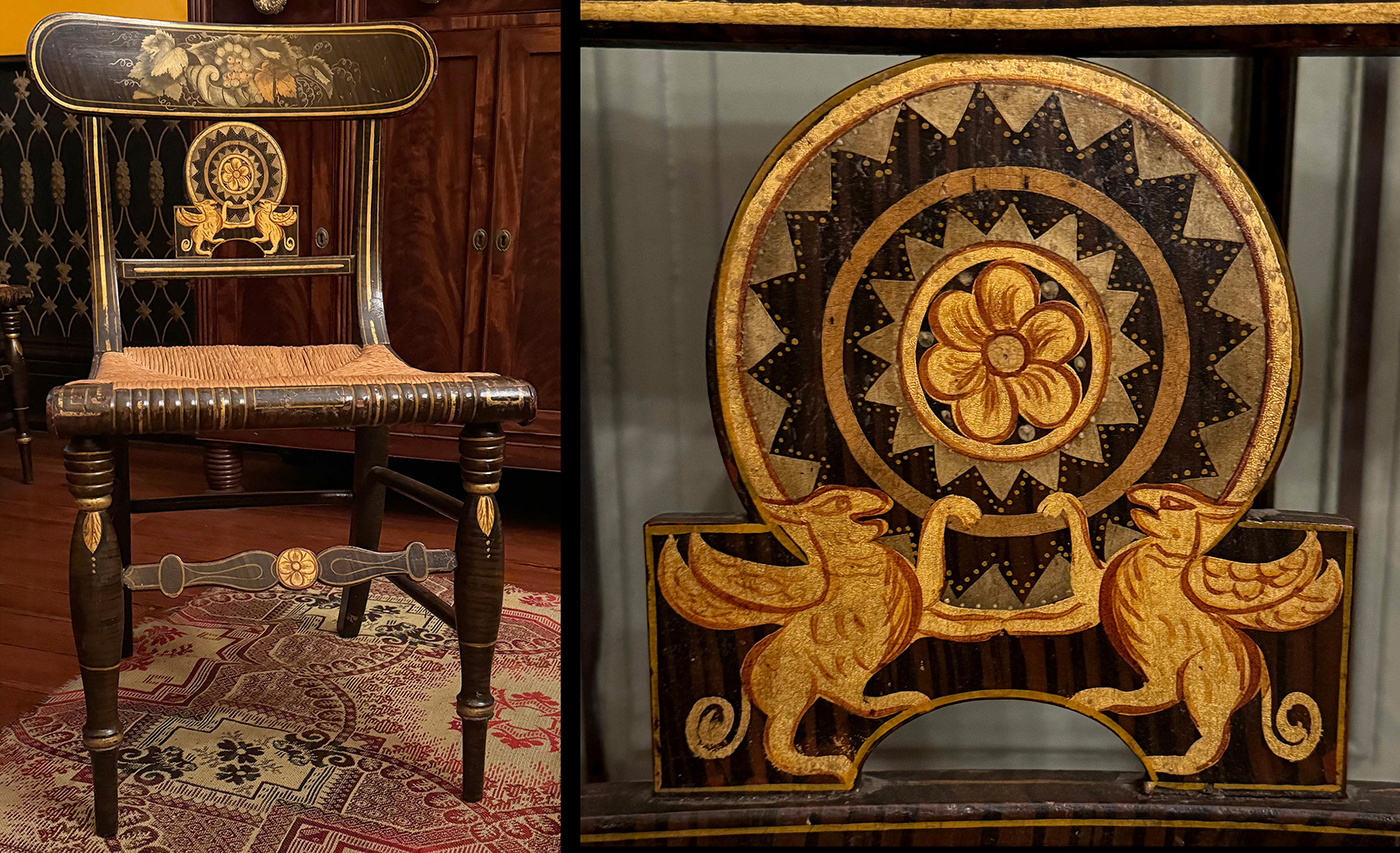
One of the four of my recently acquired fancy chairs and a closeup of it griffin splat.
Rampant Griffins
There were a number of design books, most by English authors, that succeeded Tatham’s 1799 book. As Nancy Goyne Evans has written, Thomas Hope’s 1807 book may well have been the source of the paired swans on the splat of the chair illustrated in her 2006 magazine Antiques article.
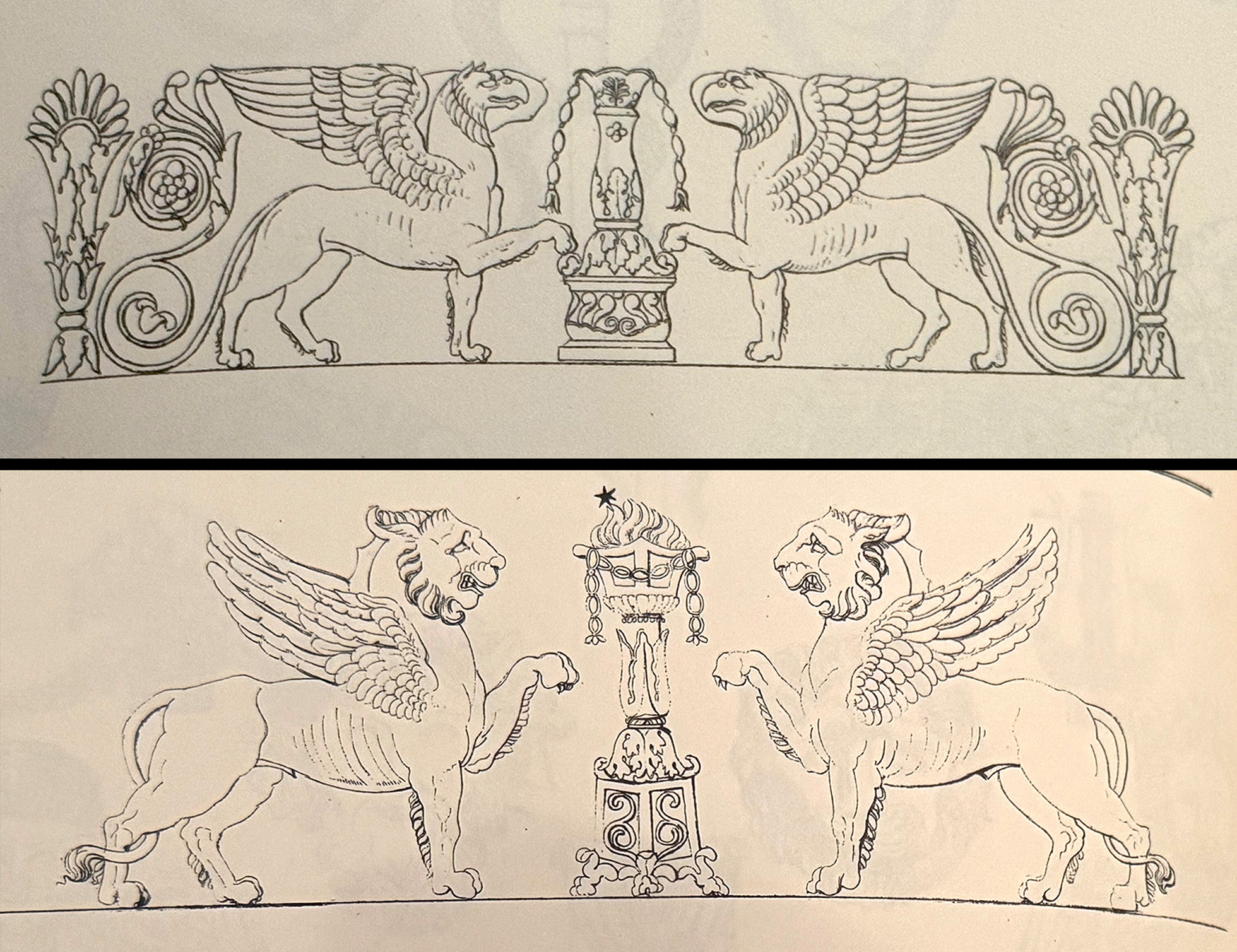
Here are two images from the 1996 Dover reprint of Selections of Ornament in Forty Pages for the Use of Sculptors, Painters, Carvers, Chasers, Embossers & issued in three 40-page volumes between 1817 of 1819 by Rudolph Ackermann.
I chose them because of the pairs of facing griffins, which in mythology had the head and wings of an eagle and the body of a lion (the top image) and evidently also was represented as a lion with wings (bottom image). The crests of the Waln side chairs have a pair of each version.
In a simplified form the griffins on my four chairs are of the eagle/lion version. But they differ from the Waln griffins and from the design book images in they these griffins have reared up on their hind legs. In heraldry they would be called rampant lions.

A simple online search for rampant lion images brings up this selection.
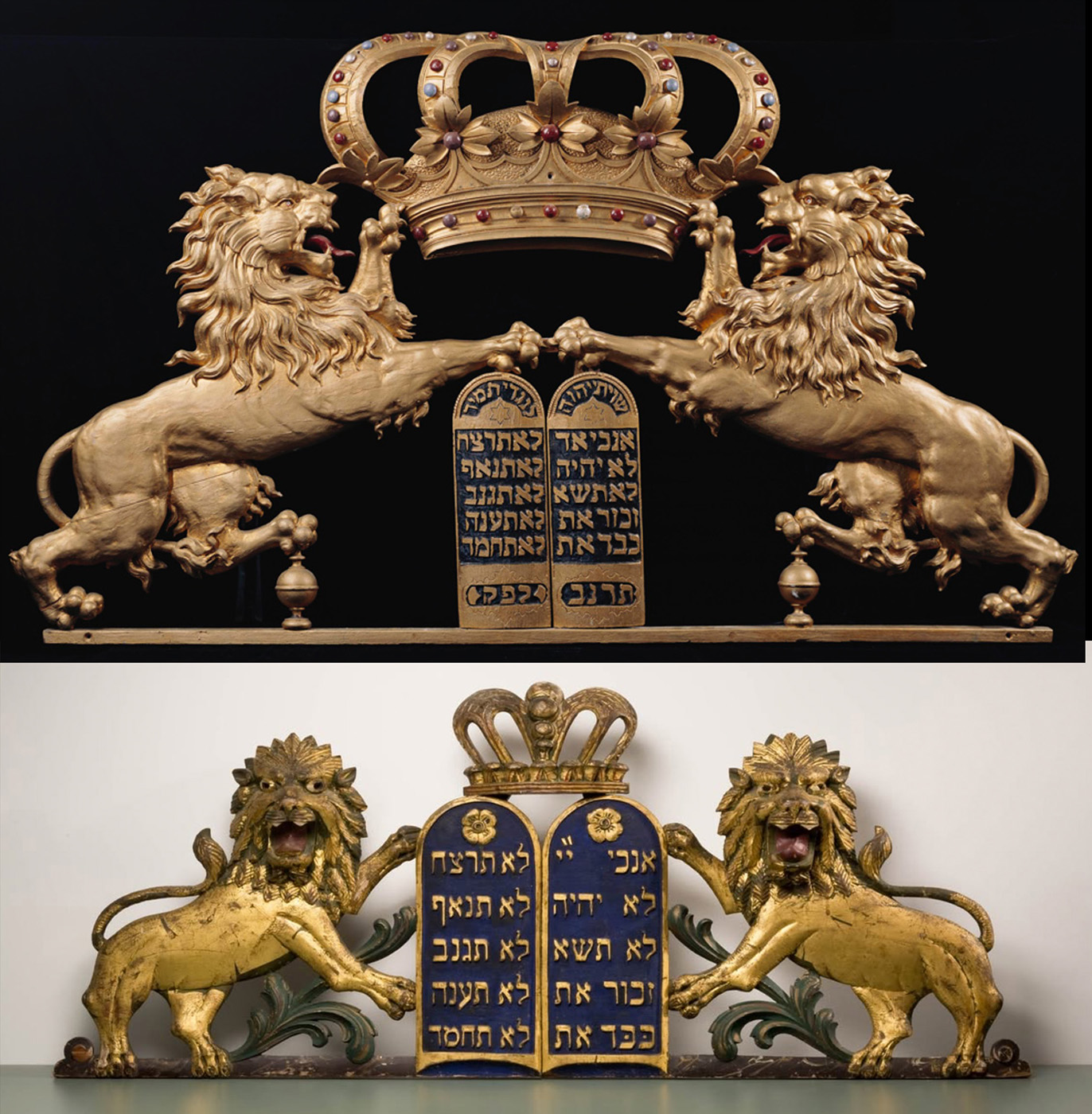
And I vividly recall that above the ark in the synagogue I attended as a child in Woodbury, NJ, was a carving of rampant lions (like the ones above) holding up the Ten Commandments.
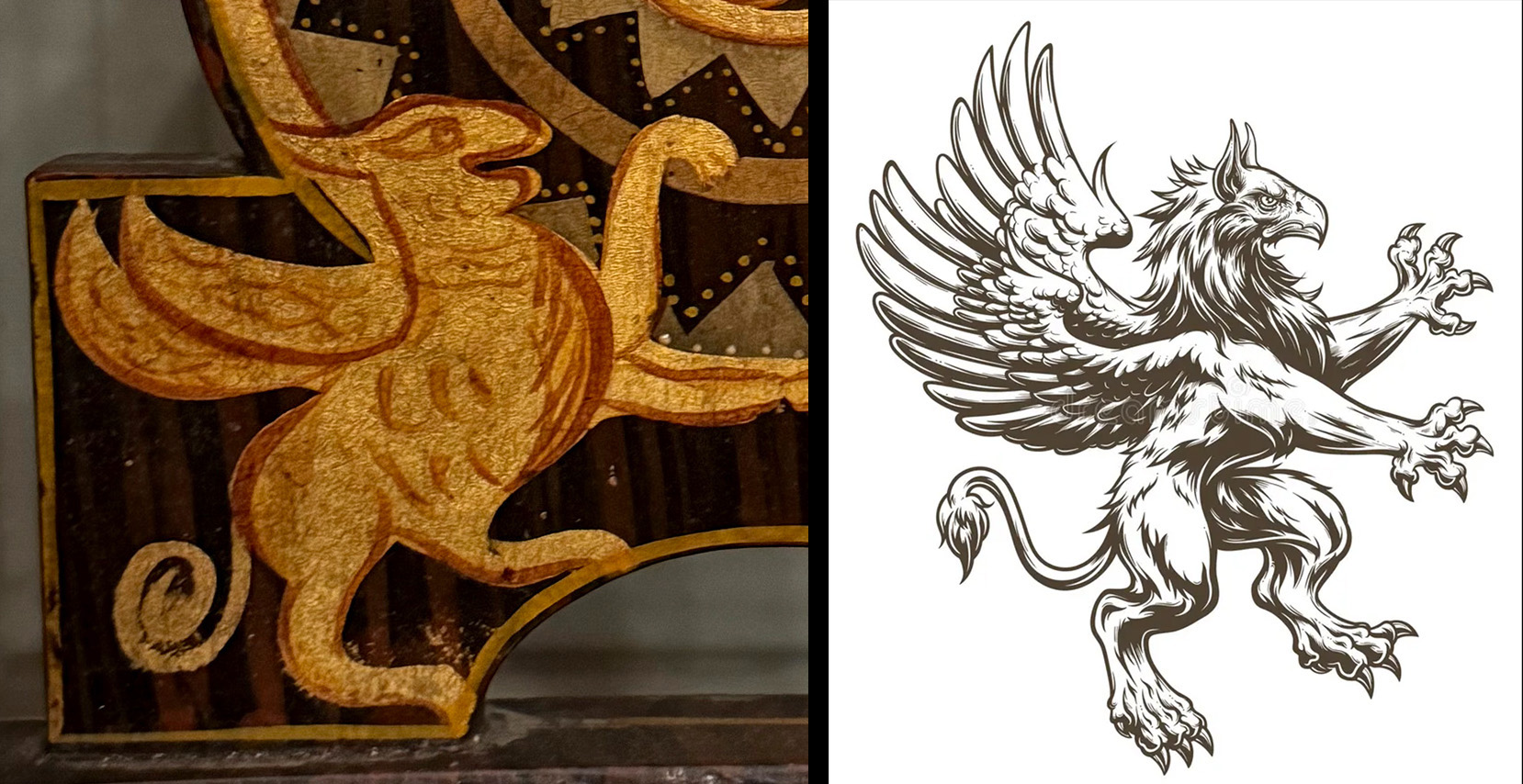
Well, the painter of the griffins on my chairs perhaps had a source for rampant griffins which I haven’t discovered or maybe took it upon himself to change the walking griffins with one paw raised into rampant griffins. The painter certainly didn’t delineate his griffins with the delicate detail found on the Waln chairs. His griffins are quite playful. They also are flawed anatomically (as much as a mythical creature has correct anatomy).
For comparisons sake I went online for “rampant griffin” and found the image on the right. This online griffin was a drawn in profile with one foreleg in full view (extensively closer to the viewer) and one leg in partial view (further from the viewer). The full curve of the chest is hidden by the foreleg in full view. On the other hand, on a griffin from my chairs the full curve of the chest is in full view; while both forelegs seem to emanate from the same side of the torso.
While naively drawn, the griffins on my chairs evoke a playfulness and energy lacking from the griffins on the crest rails of the side chairs of the Waln suite.
Now the roundels that the griffins on my chairs hold up are quite elaborate, and I wondered about the source material for them. Nancy Goyne Evans in her magazine Antiques article briefly mentions the disc above the paired swans. She writes: “Other plates in Hope’s book suggest sources for the large roundel behind the swans.” As reproduced in the Boor book on Philadelphia Empire furniture, the roundel in quite dark, but you can still discern a sunburst pattern. So I looked through Hope and spied a few roundels but none close to the one behind the swans.
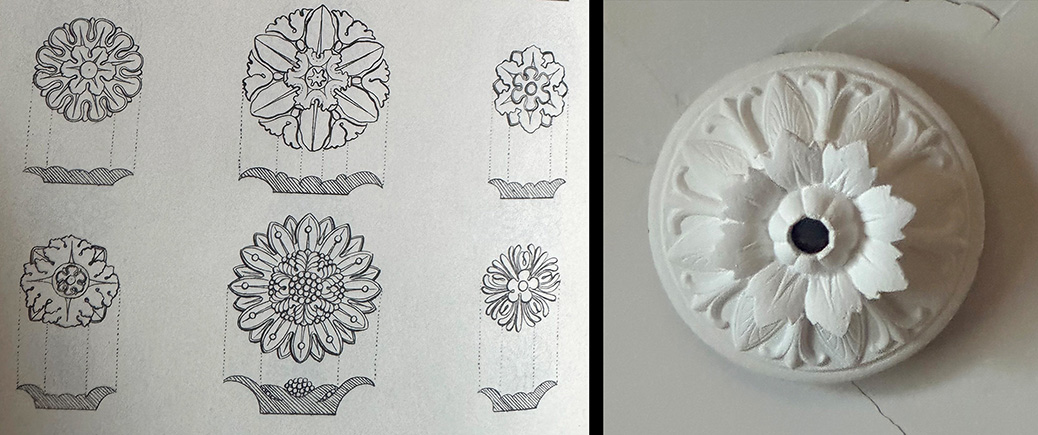
So I checked out Ackermann and found several pages of roundel designs. Above left is the lower half of Plate 19. (Ackermann provided profiles of each of these designs to indicate they were proposals for three-dimension carvings or plaster work. The image on the right is from the vestibule in my 1850s Baltimore townhouse. The hole in the center was for a gas pipe, but there was no evidence that a gasolier was ever used there.) The bottom row central roundel has the many pointed petals that could inspire the roundels on my chairs. But many of the Ackermann designs could have influenced the designer of my chairs.
Templates were used on the roundels on my chairs. The number of points on both the inner and outer serrated rings are the same on all four chairs. Then the six-petal flowers were painted with the same red pigment that details the griffins. All the dotting was done freehand as well.
Crest Rails
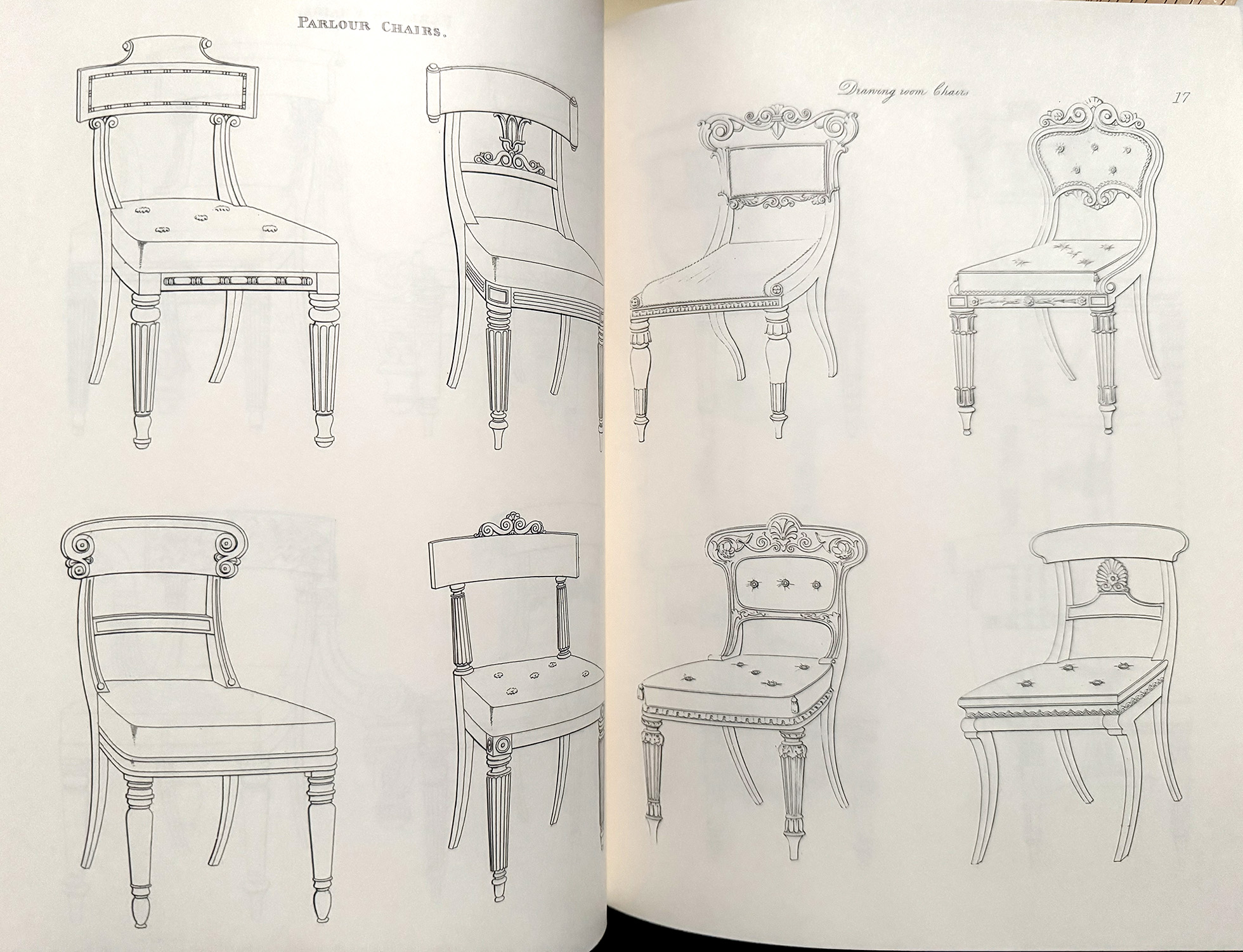
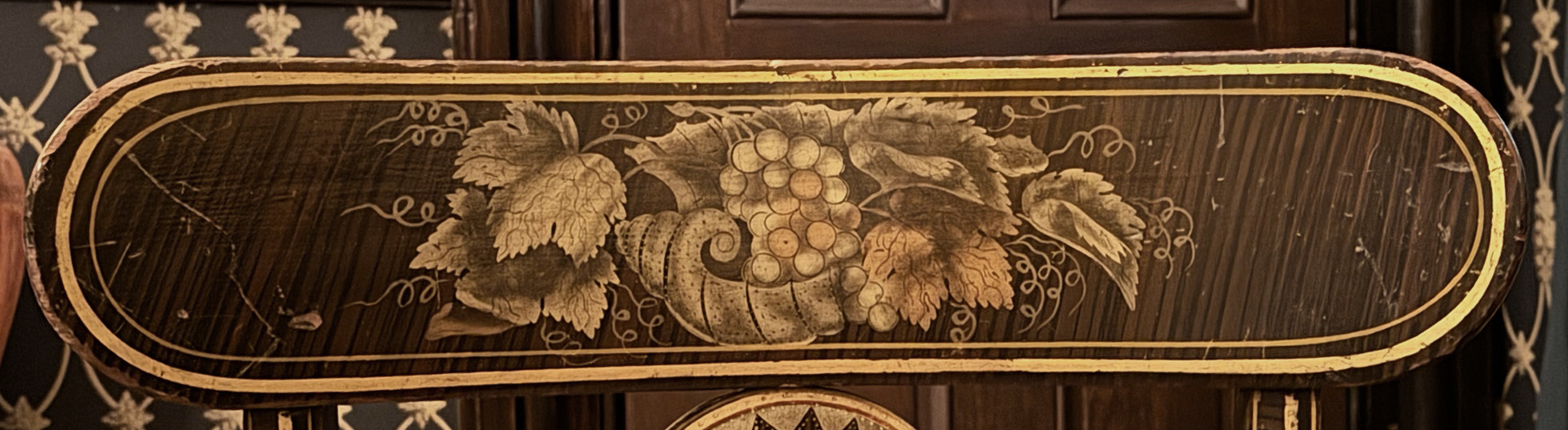
The crest rails (also called tablet tops) of my chairs are notable in several ways. The design elements were mostly applied with stencils; metallic powders were used, not gold leaf; and the details (either applied with a brush or pen) were quite delicate as opposed to the griffin/roundel splats. But there was an aspect of the crest rails that was not obvious unless you look at a lot of American early 19th-century (1800-1830) fancy chairs: the ends of the tablets were rounded off instead of squared off. Most contemporary formal, mahogany chairs with tablet top have squared ends, with one notable exception for many of those made in Boston.
That would change in the 1830s. Perhaps a catalyst for that was the publication of Thomas King’s The Modern Style of Cabinet Work Exemplified (London, 1829) . Here are two pages from the 1995 Dover reprint. On the right-hand page, the lower right chair has elements related to my chairs: a shaped splat (the form of an anthemion in this case) between the stay rail and the crest rail, and curved ends to the crest rail.
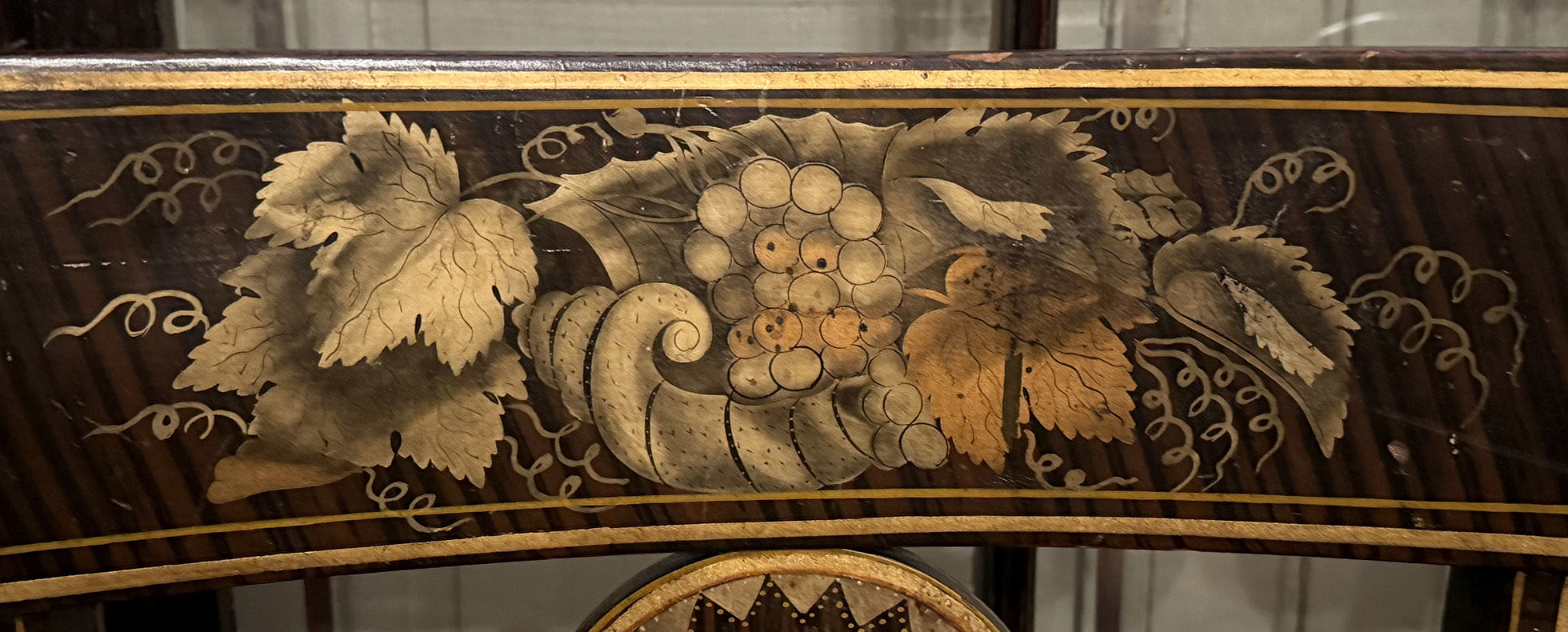 The design of the largely stenciled crest rails was quite sophisticated. The central conch shell was not the standard cornucopia with a bunch of grapes falling out of the opening. Instead the conch shell was shown on its side with grapes sitting in the opening and the far side of the shell visible behind the grapes. Several of the grape leaves were also given dimension by having part of the leaf folded out. The veinage of the leafs were described with delicate squiggles. Oddly enough, the stems for the grapes were painted on. So were the tendrils. Both silver and bronze metallic powders were used.
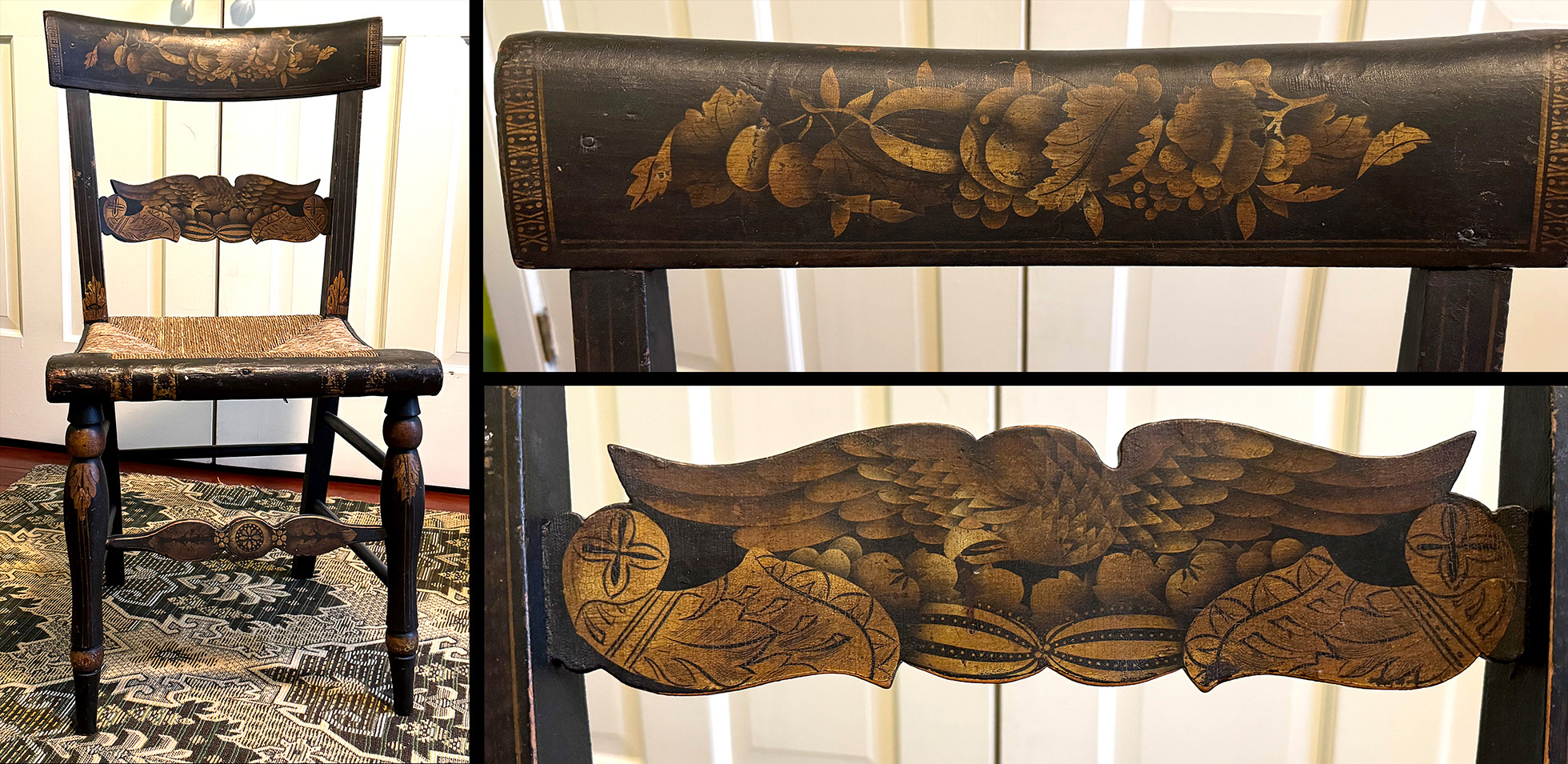
For comparison sake, here’s one of a pair of stenciled chairs with a less sophisticated version of the turned front legs on my set. The nicely stenciled eagle stay rail is what attracted me to them. Their cornucopia are very stylized. The display of fruit and foliage on the crest rails have a really nice rhythm to them. Each fruit was defined by a separate stencil as opposed to the grapes in the center of my chairs’ crest rails. There individual circles by brush or pen define each grape. On the eagle pair of chairs the stenciling showing the undersides give the leaves a sense of three dimensions. Unlike the crest rails on my set the stems to the fruit were depicted with stencils. In general the shading of the leaves and fruit enhance the sense of depth.
Conclusion
Fancy chairs were immensely popular from 1800 to 1840s. Chairs with legs very similar to those on my chairs were made from as early as 1815 to 1850, if one were to accept all of the dates attributed to chairs in the volumes cited here.
My newly purchased set of four are excellent rather refined examples in very nice shape (except for the replaced rush seats). Yet they have their quirks. The decorations of the crest and stay rails appear to be the product of different artisans or perhaps a single artisan who was more skillful at one type of decoration over another. The crest rails have rather delicate freehand work over leaves and fruit made with metallic powders applied through stencils. Yet the tendrils were painted with a heavy hand. The griffin splats are playful with a cartoon-like sensibility that give them a kinetic sense lacking in the very precise Waln chairs. The flower on the front stretcher and the leaves on the legs were painted over gilding by the same hand that did the griffins. Yet there’s no reason to suspect that the disparate applications of design elements indicate a change in the decorations were made after the chairs left the workshop.
★ ★ ★

Trackback URL: https://www.scottponemone.com/griffin-chairs-both-naive-and-refined/trackback/
Leave a Reply
-
Accessions: Short Stories Dec 21, 2025

-
The Mike and Scott Show: No Reruns Nov 25, 2025

-
Griffin Chairs: Both naive and refined Oct 04, 2025

-
Circularity: The Pairing of Two Talents Jul 12, 2025

-
Frans Masereel: Workers’ Paradise in 1939 Europe Apr 11, 2025

-
Erich Glas: Through the Night vs. Leilot/Nights Jan 15, 2025

-
Gustav Wolf: His Monster Menagerie Dec 23, 2024

-
Linos: #5 through 15 Nov 01, 2024

-
Gustav Wolf: Confessio Aug 02, 2024

-
Justin Remo’s Big Finale May 21, 2024

-
Accessions: Short Stories Dec 21, 2025
-
The Mike and Scott Show: No Reruns Nov 25, 2025
-
Griffin Chairs: Both naive and refined Oct 04, 2025
-
Circularity: The Pairing of Two Talents Jul 12, 2025
-
Frans Masereel: Workers’ Paradise in 1939 Europe Apr 11, 2025
-
Erich Glas: Through the Night vs. Leilot/Nights Jan 15, 2025
-
Gustav Wolf: His Monster Menagerie Dec 23, 2024
-
Linos: #5 through 15 Nov 01, 2024
-
Gustav Wolf: Confessio Aug 02, 2024
-
Justin Remo’s Big Finale May 21, 2024